Name
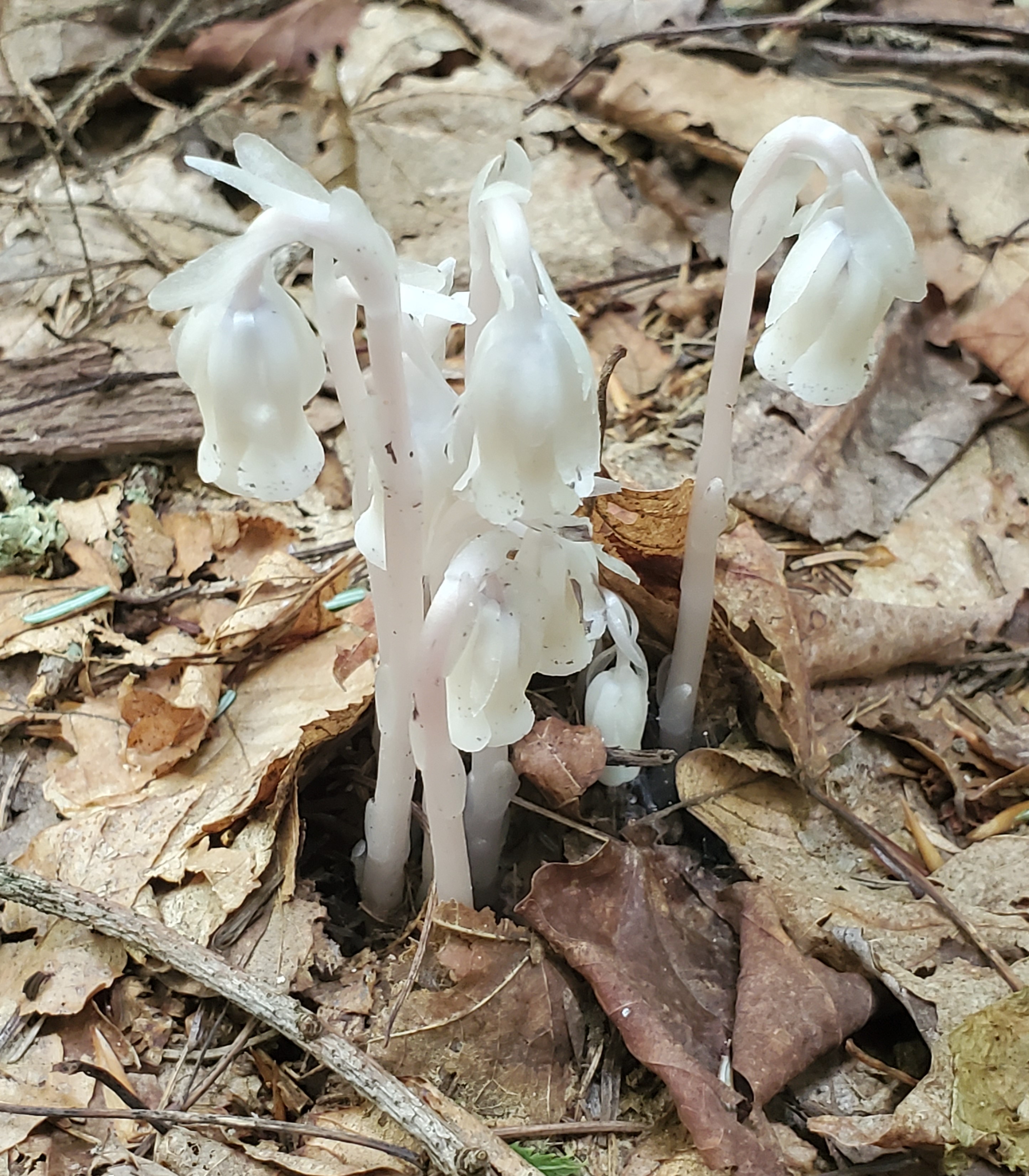
Ghost Pipe (Monotropa uniflora)
Time
Summer 2021
Place
Wayne County, Pennsylvania, USA
My Intro To This Creature
I have come across this entity several times and it always intrigues me. I always find it in a forest, shaded area, with a lot of decomposing leaves, wet and damp area, either valley or near a body of water. The specimen I collected today was found in Newfoundland, PA however I have seen it before near Bear Mountain, NY.
I suppose it is a plant, however I am not so sure. The tops have the typical flower head but turned downwards forming the shape of a cane. The whole plant is an almost translucent white with a blue hue that appears at the joints of seemingly more mature plants. The leaves, the petals, the stem, all white, except for the stamen inside the flower which have yellow tips. I have yet to see this entity in a budding stage, even when it is short.
They grow 3-6 inches tall. The ‘root’ system is quite fascinating. I collected a cluster of ten plants, dug them out, and found all ten of them attaching to a ball of small brown pili. The mass was solid and had tiny roots projecting outwards into its environment with mycelial branches communicating with it as well. This root ball tastes like fungi. The plant itself tastes bitter, reminiscent of Syrian Rue, with a tiny spicy kick when left on the tip of the tongue. There is no smell I could appreciate. I found a bumblebee interacting with the flowerhead. The plant portion itself, ‘plugs’ into the root ‘ball’ in an interesting way. There is no root system per se, in the traditional sense, for the plant portion to attach to the ‘root ball’.
I find an interesting concept represented in this entity. It has a flower-like structure, however, grows in shade and as opposed to facing the sky, it faces the ground. Seemingly devoid of chlorophyll, this is a flower that worships the darkness. It is a Flower of The Underworld.
Delving Into The Literature
This plant was originally classified into the family, Monotropacea, but reclassified into the family of, Ericaceae (also known as “heaths”). A quick google search will show you that this Ghost Pipe and members of the Heath family look absolutely nothing alike. The Heaths are herbs, shrubs, and trees that thrive in acidic soils. Most of them are evergreens with many reds and pinks for flowers and fruit. Examples of members of this family include: cranberry, blueberry, azalea, and rhododendron. The similarity between Ghost Pipe and this family of Heaths is the relationship they carry with mycorrhizal fungi.
Since it has no chlorophyll, it cannot photosynthesize. It obtains its nutrients by having its roots tap into mycelial fungi. The mycelial fungi, in turn, tap into the host tree’s roots. This kind of relationship is described by some to classify Ghost Pipe as an ‘epi-parasite’ or ‘mycoheterophyte’. The plant benefits from the efficient mineral uptake accomplished by the fungus. This withdrawal of nutrients causes a potential to develop for sugars from the host tree to be translocated into the fungal mycelial network. Contemporary scientific measures have not revealed if the Ghost Pipe gives anything in return.
Here is a detailed botanical description given by a one, W.G. Eaton:
“…has a dark colored, fibrous, perennial root, matted in masses about as large as a chestnut burr, from which arise one or more ivory white stems 4-8 in. in height, furnished with sessile, lanceolate, white, semi-transparent, approximate leaves or bracts, and bearing a large, white, terminal, solitary flower, which is at first nodding, like a downward facing smoker’s pipe, but becomes upright in fruit. The calyx is represented by two to four scale-like deciduous bracts, the lower rather distant from the corolla. The corolla is permanent, of 5 distinct, erect, fleshy petals, which are narrowed below with a small nectariferous pit at the base. Stamens 10, sometimes 8; anthers short on the thickened apex of the hairy filament…”
Medicinal Properties
Ghost Pipe is a tonic, sedative, nervine, and anti-spasmodic. It has been employed in febrile diseases as a sedative a diaphoretic. The powder has been employed in instances of restlessness, pains, nervous instability, and as a substitute for opium without many deleterious influences. [King’s American dispensary, pg 606]
Reported: In convulsions of children, epilepsy, chorea, and other spasmodic affections, its administrations has been followed with prompt success.
Reported: The juice of the planet, alone or combined with rose water, has been found to be an excellent applications for obstinate ophthalmic inflammation, to ulcers, and as an injection in gonorrhea, inflammation and ulceration of the bladder. Dose of the powdered root is from 1/2 – 1 drachm (1.75 – 3.5 grams), 2-3x/day.
Reported: It has also been used in cases of acute anxiety and/or psychotic episodes due to intense drug experiences. The herbal preparation of aerial parts given 1-3 mL doses has in numerous cases given quick relief to these episodes within 15-30 minutes at which point the patient falls asleep to awake calm and clear in a few hours. It seems in these cases, a repressed traumatic memory emerges from the depths of the subconscious, putting the person into a state of emotional and/or sensory overload. It has been used effectively in treating severe mental and emotional pain due to PTSD and other traumatic injury, as well as severe nerve pain due to Lyme disease.
Personal Experience: A tincture of ghost pipe was administered to a person who was displaying violent and aggressive behavior after ingesting psilocybin mushrooms. They were threatening to smash furniture, shouting, and verbally antagonizing the people around them. After making a physical attempt on another person they were quickly restrained with rope. They were given 5 mL of the ghost pipe tincture. Within 20 minutes the behavior regressed into calm blabbering and crying.
Myths & Legends
There is a Cherokee legend about the Ghost Pipe:
Long ago, when selfishness first entered the World, people began quarreling, first with their own families and tribal members, then with other tribes. The chiefs of the several tribes met together to try and solve the problem of quarreling. They smoked a peace pipe together, while continuing to quarrel among themselves for the next seven days and seven nights. In punishment for smoking the peace pipe before actually making Peace, Great Spirit turned the chiefs into grey flowers and made them grow where relatives and friends have quarreled.
Proving Themes & Dreamwork
For Ghost Pipe to survive it must become confluent with the mycelium of fungus, that in turn becomes confluent with tree roots for its nutrition. Also, the structure above ground loses its boundary and melts away when handled. The feeling of having no boundaries between oneself and The Void, of being naked and exposed is perhaps the most basic feeling here. Vulnerable boundaries, loss of direction, disconnection, confusion, and not belonging to family or group.
They have the feeling they are only tolerated and are not really accepted anymore. They often live in poor conditions which they can do since they often don’t need very much. They may long for recognition and compliments. In the end they can become bitter. They may see themselves as unimportant, taking no place, having few needs, offering themselves for others.
For loneliness, those who are always seeking companionship of anyone who may be available, as if they find it necessary to discuss their own affairs with others. This is a powerful resonance with Ghost Pipe with its issues of being tapped in, carried by the flow, and its opposite state of being blocked, of having the flow cut off, feeling isolated, numbed out, alienated. Because Ghost Pipe is an epiparasite and relies completely on its host for nutrition.
 The Medicine Way